post
Decomposing Numbers to Add – Grab This Free Worksheet Now

Decompose to Add with no Regrouping
Grade often used by:
2nd Grade | 3rd Grade
Subject:
Math | Measurement and Data | Place Value
Standards:
Common Core State Standard:
2.NBT.B.9
3 Easy Ways to Teach Decomposing Numbers to Add (Free Worksheet)
If you're looking for an effective way to help students master mental math strategies, decomposing numbers to add is a perfect place to start. This foundational concept helps kids break numbers into friendlier parts, making it easier to solve addition problems in their heads. Whether you're a teacher, a parent, or a homeschooler, understanding and teaching this strategy is a must. In this guide, we’ll explore three easy ways to teach decomposing numbers, and at the end, you'll find a free downloadable worksheet that reinforces these concepts. If you're searching for a decomposing numbers to add download free worksheet — you're in the right place.What Is Decomposing Numbers to Add?
Decomposing numbers simply means breaking them into parts based on place value. For example: 45 = 40 + 5 37 = 30 + 7 Now, when we add 45 + 37, we break it down like this: 40 + 30 = 70 5 + 7 = 12 70 + 12 = 82 This method helps kids visualize what’s happening when they add — they're not just memorizing steps, they’re understanding numbers.Why Decomposition Helps Kids
Decomposing numbers to add builds two essential skills:- Place value understanding – Kids see how tens and ones work together.
- Mental math fluency – They solve more problems in their head, improving speed and confidence.
Teach First: Expanded Form
Before jumping into decomposing numbers, students should know how to write numbers in expanded form. For example: 82 = 80 + 2 47 = 40 + 7 This teaches them how numbers are built, which is the first step to breaking them apart. Start with simple practice writing 2-digit numbers in expanded form, then move to addition.Strategy #1: Use Base Ten Blocks
Hands-on tools like base ten blocks make this concept more concrete. Here’s how:- Have students build two numbers (e.g., 34 and 25).
- Ask them to physically group the tens and the ones.
- Add the tens (30 + 20) and the ones (4 + 5).
- Then combine both parts to find the final answer.
Strategy #2: Number Bonds
Number bonds help students decompose in a visual way. Draw circles that show how a number is made up of smaller parts. For example:45 / 40 5Once students understand number bonds, they can create their own for two numbers and then add the parts. Example for 45 + 27: 45 = 40 + 5 27 = 20 + 7 Add: 40 + 20 = 60; 5 + 7 = 12 → 60 + 12 = 72 This reinforces both place value and part-part-whole relationships.
Strategy #3: Compensation
Compensation is a mental math trick that’s perfect for advanced decomposing. Here’s how it works: Let’s add 56 + 38. Notice that 38 is close to 40. So:- Add 2 to 38 to make 40.
- Subtract 2 from 56 → now we have 54 + 40 = 94
Download the Free Worksheet
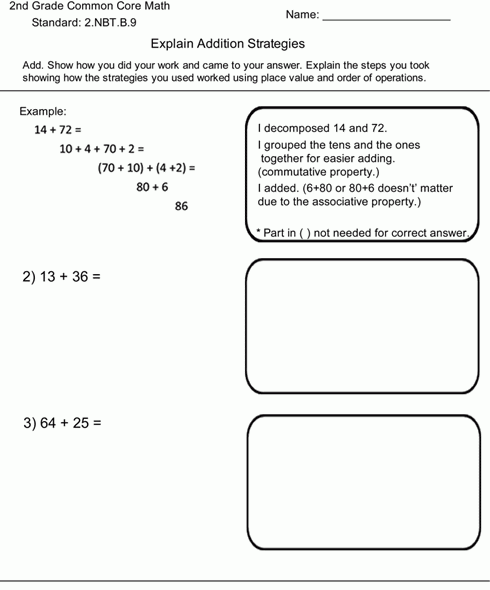
To put these strategies into practice, we’ve created a free worksheet that focuses on decomposing numbers to add. It’s great for early practice because:- It includes only two problems, so it won’t overwhelm students.
- It avoids regrouping, keeping things simple.
- It’s designed for 2nd grade but can also be used for remediation or review in 3rd grade.
Download Free Worksheet
How to Introduce Decomposing Numbers in the Classroom
When introducing decomposing numbers to add, it’s best to start small and build up. Use numbers that do not require regrouping and pair them with strong visuals. Here’s a simple three-day structure to follow:Day 1: Visual Introduction
- Use base ten blocks or number charts.
- Write two-digit numbers in expanded form.
- Model one or two decomposing problems with student participation.
Day 2: Guided Practice
- Use number bonds and equation mats.
- Pair students to work on breaking apart numbers visually.
- Model “think-aloud” strategies as you decompose numbers in front of the class.
Day 3: Independent Practice
- Use the free decomposing numbers worksheet for students to practice independently.
- Have students explain their thinking or write how they broke apart the numbers.
- Introduce an exit ticket with one decomposing problem for assessment.
Common Misconceptions When Decomposing Numbers
It’s common for students to misunderstand what they’re supposed to do when first learning how to decompose numbers. Some of the most common mistakes include:- Only breaking down one number (instead of both in an equation).
- Misplacing value (e.g., thinking 45 = 5 + 4 instead of 40 + 5).
- Trying to regroup too soon without understanding place value first.
Helpful Tips for Parents at Home
If you’re a parent supporting your child with math homework or remote learning, here are a few tips for helping your child use this strategy at home:- Have your child explain how they broke apart each number aloud.
- Use small objects (like coins or counters) to represent tens and ones.
- Print out a number chart or base ten visuals to give your child a visual reference.
- Reinforce that decomposing is just a different way to look at numbers — not a trick.
Connection to Common Core Standards
This strategy directly supports the Common Core Math Standard 2.NBT.B.9:“Explain why addition and subtraction strategies work, using place value and the properties of operations.”Decomposing numbers to add aligns perfectly with this goal. It encourages students to go beyond rote computation and instead develop reasoning and number sense.
When to Teach Decomposing Numbers
I typically introduce decomposing after students have mastered the following concepts:- Understanding place value (tens and ones).
- Writing numbers in expanded form.
- Basic one- and two-digit addition facts.
Why This Free Worksheet Works
The worksheet we’ve provided is ideal for introducing this concept because it’s intentionally simple:- It focuses only on addition.
- It avoids regrouping, which can confuse students at this stage.
- It provides space for students to show their thinking — not just get the right answer.
Research supports the idea that students benefit more from number sense strategies like decomposing, rather than memorization alone. According to a Stanford study by Dr. Jo Boaler, developing fluency through strategy use—such as breaking numbers apart—is far more effective and less anxiety-inducing than rote drills.
Read more about this research on Fluency Without Fear by YouCubed at Stanford.